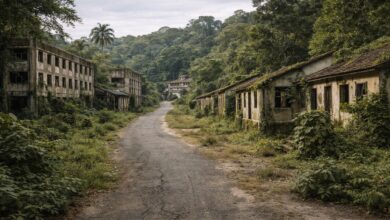
On the eastern edge of Singapore, behind fences and dense vegetation, the former Old Changi Hospital remains largely intact yet unused. Built during the early 20th century and later expanded for wartime needs, the hospital once served as a critical medical facility for military personnel and civilians. After the war, its role diminished, and by the late 20th century it was abandoned. What endures today is not a functioning institution, but a structure whose corridors and wards continue to anchor local accounts and collective memory.
Old Changi Hospital is often framed through atmosphere. However, its reputation is grounded in documented history, architectural design, and the psychological impact of deserted medical spaces. The building does not rely on speculation to feel significant. Its presence alone communicates the weight of what once occurred there.
A hospital built for military medicine
Old Changi Hospital was originally constructed as part of a broader military infrastructure established by colonial authorities. Its location near the coast and airfields made it strategically valuable. The complex was designed to treat injuries, manage infectious disease, and provide long term care for service members.
Medical buildings of this era prioritized efficiency and segregation. Wards were arranged to separate patients by condition. Long corridors connected treatment rooms, operating spaces, and recovery areas. The architecture reflected function rather than comfort. Similar human responses to silence and environment appear in Asylum 49 in Utah’s Tooele Valley.
This design would later influence how the abandoned structure was perceived.
Wartime expansion and pressure
During the Second World War, the hospital experienced intense use. Singapore’s strategic position brought large numbers of wounded and ill personnel. Resources were strained. Medical staff worked under extreme pressure.
Wards filled quickly. Corridors became transitional spaces where stretchers passed continuously. Records indicate high patient turnover and difficult conditions, common to wartime hospitals globally.
The building absorbed these pressures physically and symbolically.
Postwar transition and decline
After the war, medical infrastructure across Singapore evolved rapidly. New hospitals were built with updated standards and equipment. Older military facilities like Old Changi Hospital became less suitable for modern healthcare.
Gradually, services were relocated. Portions of the complex fell out of use. Maintenance slowed. Eventually, the hospital ceased operations entirely.
Unlike sudden abandonment caused by disaster, Old Changi’s closure was administrative and gradual.
The architecture of emptiness
Hospital architecture is designed around presence. Beds, staff movement, and patient care define purpose. When emptied, that purpose becomes conspicuous by its absence.
At Old Changi Hospital, long corridors extend without destination. Wards retain their proportions but lack activity. Windows admit light into rooms that no longer respond.
This mismatch between design and use intensifies perception.
Corridors as memory spaces
Local accounts frequently focus on corridors. These spaces once connected life saving activity. In abandonment, they became long, uninterrupted passages that amplify sound and distance.
Corridors concentrate expectation. They suggest movement even when still. In Old Changi Hospital, they remain the most discussed feature, not because of events recorded there, but because of how they frame experience.
Movement without movement creates unease.
Wards and repetition
Hospital wards are repetitive by necessity. Identical rooms line hallways. Beds once occupied similar positions. Routine governed daily life.
After abandonment, this repetition remains without context. Empty wards feel interchangeable yet specific. The mind attempts to assign narrative to each space.
This psychological effect explains why accounts often cluster around wards rather than administrative offices or exteriors.
Local accounts and interpretation
Over time, stories circulated among nearby communities, focusing on sensations experienced within the building. These accounts emphasize atmosphere rather than incident. Feelings of unease, disorientation, or heightened awareness are common themes.
Such responses align with known psychological reactions to abandoned institutional spaces. Hospitals, in particular, carry associations with vulnerability and loss.
The accounts reflect perception rather than documented events.
Distinguishing history from narrative
There is no verified record of unexplained phenomena at Old Changi Hospital. Its significance arises from how history, architecture, and abandonment intersect.
Wartime use introduced intensity. Medical purpose introduced vulnerability. Abandonment introduced silence.
Together, these elements created an environment that invites interpretation.
Environmental factors
Singapore’s tropical climate accelerated visible decay. Moisture affected walls and ceilings. Vegetation encroached on open areas. Paint peeled and surfaces darkened.
This decay altered sensory experience. Smell, humidity, and texture contribute to perception. Such changes do not indicate danger, but they influence mood.
Environmental conditions amplified the building’s presence.
Restricted access and distance
For many years, access to Old Changi Hospital was limited. Restricted spaces often generate speculation simply because they are unseen.
Distance fuels imagination. When people cannot enter freely, narratives fill the gap.
As access policies changed over time, the building’s reputation had already formed.
Comparison with other abandoned hospitals
Globally, abandoned hospitals often develop similar reputations. Their associations with pain, recovery, and mortality make emptiness feel unnatural.
Old Changi Hospital fits this pattern. It is not unique in function, but it is distinctive in context.
Its wartime history and isolation reinforce its image.
Memory without restoration
Unlike heritage sites that undergo restoration and reinterpretation, Old Changi Hospital remains largely untouched. There are no curated exhibits. No guided narrative shapes understanding.
This absence of interpretation allows personal response to dominate.
The building does not instruct. It presents.
Silence and scale
Silence plays a major role in how Old Changi Hospital is perceived. Large interior spaces absorb sound. Footsteps echo briefly, then vanish.
Scale compounds this effect. High ceilings and long sightlines make individuals feel small.
Silence combined with scale heightens awareness of self.
Emotional residue as concept
The idea of emotional residue does not imply something left behind physically. It describes how spaces retain association through use.
Hospitals accumulate emotional meaning because of what occurs there. When abandoned, those meanings do not disappear. They become unanchored.
Old Changi Hospital exemplifies this process.
Why the reputation persists
The hospital’s reputation persists because it is reinforced by architecture, history, and narrative repetition. None alone would be sufficient.
The building remains visible. Stories circulate locally. The past is documented.
Together, they maintain relevance.
Between respect and restraint
Responsible engagement with Old Changi Hospital requires restraint. Sensational framing risks obscuring historical function. The building was a place of care as much as suffering.
Understanding this balance preserves integrity.
The hospital’s significance lies in remembering function, not exaggerating absence.
A site shaped by transition
Old Changi Hospital stands at the intersection of military history and medical evolution. It reflects how institutions are built for specific needs and later rendered obsolete.
Its abandonment is not failure. It is transition.
The building marks a shift in healthcare and governance.
Why Old Changi matters today
Old Changi Hospital matters because it shows how places retain meaning after use ends. Architecture continues to communicate intention long after function ceases.
It also illustrates how communities interpret silence and decay through shared narrative.
The hospital’s story is not about what cannot be explained. It is about how memory operates in space.
A building that invites reflection
Walking past Old Changi Hospital today, one encounters walls that once contained urgency. Windows that once monitored recovery now reflect trees.
The building has not changed location. Its role has changed.
That contrast defines its presence.
Between history and perception
Old Changi Hospital occupies a space between documented history and lived perception. Both are valid. Neither replaces the other.
Understanding the site requires acknowledging both without conflation.
The building does not demand belief. It demands attention.
A quiet legacy
Old Changi Hospital remains a former military hospital abandoned after war, remembered through corridors and wards rather than events alone. Its emotional residue is not mystery, but continuity of association.
The structure stands as evidence that places built for care do not lose significance when emptied. They transform. Related reflections on memory and perception can also be found in walls of Kilmainham Gaol.
In that transformation, memory finds space to persist.
Horizon Report documents places shaped by memory, infrastructure, and human decisions. Our editorial approach focuses on what remains physically visible, how abandonment unfolds over time, and how interpretation is clearly separated from observable evidence.
For readers seeking deeper context, the following background articles explore how ghost towns emerge, why communities are left behind, and why preservation matters in understanding collective history.
- Abandonment And Ghost Towns
- What Is A Ghost Town
- Why Towns Are Abandoned
- Preserving Abandoned Places
Editorial transparency matters. Observations are grounded in site layout, materials, remaining structures, and documented timelines where available. Interpretive layers are presented as interpretation, not assertion.
Careful readers often notice details worth refining. Thoughtful feedback helps ensure accuracy, clarity, and long term editorial integrity.